
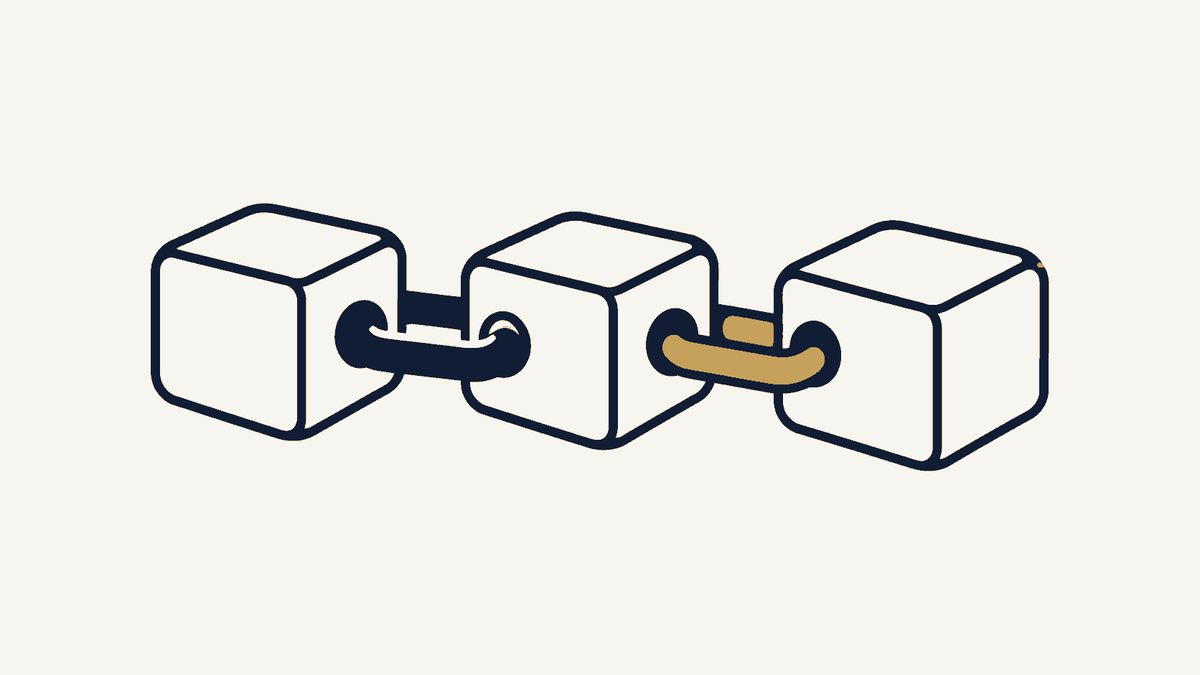
A blockchain is a shared record book that thousands of computers keep identical copies of, updated in batches called blocks, where each new batch is cryptographically chained to the previous one so that history cannot be quietly rewritten. That is the whole idea.
Everything else, the mining, the tokens, the vocabulary, is machinery built to answer one question: how do you get strangers who do not trust each other to agree on a single record, without putting anyone in charge of it?
The problem: records need a referee
Every system of value is really a system of records. Your bank balance is a row in a database. Your house is yours because a registry says so. And all of those records share a structure: one trusted institution keeps the master copy. The bank says what you have; the registry says what you own.
That works, mostly, but the referee is also a gatekeeper and a single point of failure. It can deny you service, make mistakes, get hacked, or be pressured. For digital money the problem is sharper still: a digital thing can be copied, so without a referee checking the ledger, what stops someone from spending the same money twice?
For decades the assumption was that you simply cannot have digital records without a referee. Blockchain is the discovery that you can.
The solution, built in four steps
Step one: everyone gets the book. Instead of one master copy, every participating computer (a node) holds the complete record of every transaction ever made. Tampering with one copy achieves nothing when thousands of others disagree with it.
Step two: updates travel in blocks. New transactions are collected into batches, blocks, added at a steady rhythm. Bitcoin adds one roughly every ten minutes. Each block carries a cryptographic fingerprint, a hash, of the block before it. A hash is a short code computed from data, with the property that changing even one character of the data produces a completely different code. Because each block contains the fingerprint of the last, the blocks form a chain, and editing any old block changes its fingerprint, visibly breaking every block after it. That is the “chain” in blockchain, and it is what makes history tamper-evident.
Step three: someone must win the right to write. If anyone could add blocks freely, an attacker would add fraudulent ones. So blockchains make writing expensive. In proof of work, Bitcoin’s method, computers called miners compete in a lottery that costs real electricity to play; the winner adds the block and collects newly created coins plus fees. Lying is possible but ruinously unprofitable: you would burn the same electricity and the network would reject your block. In proof of stake, used by Ethereum since September 2022 and most newer networks, the role goes to validators who lock up their own coins as collateral, which the network can destroy if they cheat. Different costs, same logic: make honesty the profitable strategy.
Step four: the longest honest record wins. When versions of history conflict, nodes follow the chain with the most accumulated work or stake behind it. To rewrite history, an attacker would need to outspend the entire honest network sustainably. On a large chain, that cost is measured in billions.
Put together: a record everyone holds, chained so it cannot be silently edited, written by parties who must pay to participate and lose money by cheating. Strangers, agreeing on one history, with no referee.
What this bought, and what it cost
The genuine achievement is digital scarcity and settlement without an institution. A bitcoin cannot be copy-pasted. A transfer, once buried under enough blocks, is final. No account can be frozen by a manager, because there is no manager. This is the foundation that What Is Bitcoin and Why It Still Matters builds on, and once the ledger could run programs as well as payments, it became the foundation of an entire application layer, covered in What Is DeFi, Explained for Someone Who Banks Normally.
The costs are just as real, and an honest explainer names them. Replication is expensive: thousands of computers doing redundant work will never be as fast or cheap as one database, which is why blockchains make sense only where neutrality is worth paying for. Finality cuts both ways: no manager means no fraud department, and a mistaken or stolen transfer is simply gone. And openness has limits: every transaction is public forever, which is transparency or surveillance depending on where you stand.
One more cost deserves its own sentence: “blockchain” became a marketing word. Through the 2017 and 2021 cycles, projects with no need for neutrality bolted the word onto ordinary databases. A useful filter: if all the participants already trust one institution, a database is better. Blockchains earn their cost only among parties who cannot or will not trust a referee.
The two words that unlock the rest
With the model in place, most crypto vocabulary falls into one of two buckets.
Coins are the native asset of a blockchain, the thing the ledger itself tracks and pays its writers with: bitcoin on Bitcoin, ether on Ethereum. Tokens are assets created by programs running on top of an existing blockchain, borrowing its security instead of running their own. Most of the thousands of assets in the market are tokens, and the distinction tells you who an asset ultimately depends on: Coins vs Tokens: The Difference That Explains Half the Market.
And because independent blockchains compete to be the base layer applications build on, the market sorts them into families, Layer 1s against Layer 1s, mapped in What Are Altcoins (and What They Are Not) and profiled asset by asset in our Altcoin Explorer.
The test of whether you got it
Forget the vocabulary and try the one-sentence version: a blockchain is a way for strangers to keep one shared record that nobody controls and nobody can quietly rewrite, because writing costs money and cheating costs more. If that sentence makes sense, you understand blockchain better than most of the people who used the word in a pitch deck during the last bull market.
Quick answers
Is blockchain the same thing as Bitcoin? No. Bitcoin is the first and largest application of a blockchain; the blockchain is the record-keeping method underneath it. Thousands of networks now use the method for different purposes.
Can a blockchain be hacked? The major chains’ ledgers have never been rewritten; the economics make it prohibitive. What gets hacked constantly is everything around them: exchanges, applications, smart contracts, and individual wallets. “Crypto hack” headlines are almost always about the buildings, not the ground.
Who pays for all those computers? The networks pay their own operators: miners and validators earn newly issued coins and transaction fees. That self-funding loop is why the system runs without a company behind it, and why every blockchain needs a native coin.
Is blockchain useful outside crypto? Narrowly. The honest test is whether the participants need a record that no single party controls. Where one trusted institution already exists, an ordinary database is faster and cheaper; most corporate “blockchain” projects of the 2017-2020 wave quietly concluded exactly that.
What the record book cannot tell you is why the assets written in it swing in value the way they do. That is a story about people, not technology, and it starts with How Crypto Prices Actually Move: Who Buys, Who Sells, Who Pushes.
Figures in this article are as of October 2026. Prices, supplies and product details change quickly in crypto, so check the sources below for current numbers.
Sources
- Satoshi Nakamoto, Bitcoin: A Peer-to-Peer Electronic Cash System, 2008.
- ethereum.org, The Merge, 2026.
Get the real story behind every market move. Subscribe to Crypto Unlocked.


